


Can You Bring a Power Bank on a Plane? Wh Limits Explained
Can You Bring a Power Bank on a Plane? Wh Limits Explained
Yes, usually—if its watt-hour rating and your airline’s rules allow it. Pack the bank in your cabin bag, inspect the printed Wh, and know the current restrictions before you leave for the airport.
Carry-on rules · Wh examples · Airline checklistA portable charger is often the last thing a traveler puts in a bag. It is also one of the few accessories that can change which bag you may use, how many units you may bring, and whether you need airline approval. The familiar advice “under 100Wh is fine” is a useful starting point, but it is not the full answer for every international flight in 2026. Airline policies and international guidance have become more specific about power banks, including quantity and use during the flight.
Power bank flight rules at a glance
The U.S. FAA describes power banks as spare lithium-ion batteries. That means they must travel in the passenger cabin. A laptop or phone with its battery installed is a different case; the separate external charger is the item you must keep out of checked baggage. TSA’s power-bank page likewise says these spare lithium batteries are prohibited in checked luggage. Security screening and permission to carry an item are separate from an airline’s operational policy, so a TSA listing alone does not settle every flight.
| Printed lithium-ion capacity | FAA U.S. baseline | What to do |
|---|---|---|
| Up to 100Wh | Generally allowed in cabin for personal use. | Check airline quantity and onboard-use policy; protect from damage and short circuits. |
| Over 100Wh up to 160Wh | Air carrier approval required; up to two larger spare batteries per person under FAA guidance. | Contact each operating carrier well in advance. Do not assume an international airline accepts large power banks. |
| Over 160Wh | Generally forbidden on passenger aircraft. | Do not pack it as normal passenger baggage; seek an appropriate alternative. |
This is a summary of the FAA baseline, not a promise that any airline will accept a specific product. The FAA says many domestic and international airlines can impose stricter quantity and Wh limits. Crucially, IATA’s 2026 operator guidance separates power banks from other spare batteries and its table lists power banks over 100Wh through 160Wh as forbidden, even though the discussion also describes an interim operator-approval provision. Implementation depends on national adoption and carrier practice. For a cross-border trip, choose a clearly labeled bank at or below 100Wh and verify the actual airline policy; do not rely on an approval possibility without explicit confirmation.
Does 100Wh mean 100W output?
No. Wh measures stored energy and sets the aviation capacity threshold. W measures charging power or output rate. A 20,000mAh bank with a 65W USB-C port can have about 74Wh of stored energy if its cell rating is 3.7V. A 250W combined-output model can still have a sub-100Wh battery. The numbers describe different things, and a product headline often emphasizes the larger output number. Read the capacity line on the body of the device or its verified specifications.
How many power banks can you bring?
The FAA FAQ says no quantity limit for rechargeable batteries under 100Wh when they are for the passenger’s personal use, but it warns that airlines can be stricter. IATA’s March 2026 power-bank guidance imposes a maximum of two power banks per person in its addendum, while also explaining that legal enforceability and timing depend on a country’s adoption and the operator’s policy. These statements address different governing contexts. The practical approach is to take no more than two unless your operating airline clearly permits otherwise, and to confirm its policy if you need more. The two-larger-spares FAA limit for 101–160Wh is not blanket permission for two such banks on every airline.
How to calculate Wh from a mAh label
If your power bank already prints a watt-hour rating, use that value first. If it only lists milliamp-hours and the nominal battery voltage, divide mAh by 1,000, then multiply by that voltage. The common example voltage of 3.7V is not universal. Do not use a USB-C output voltage such as 5V, 9V, or 20V unless the capacity explicitly refers to that output measurement.
At 3.7V, a 10,000mAh bank is approximately 37Wh; 20,000mAh is about 74Wh; 27,000mAh is 99.9Wh; and 30,000mAh is 111Wh. Those are illustrative calculations, not certified ratings for every model bearing those mAh numbers. A 27,000mAh bank using a 3.85V nominal rating would calculate to about 104Wh and cross the familiar 100Wh threshold. Product cell configurations and rounding also vary. The actual printed Wh and airline policy matter more than a generic “27,000mAh rule.”
For a deeper explanation of why the bank’s advertised mAh differs from usable USB output, see our power bank mAh vs Wh guide. This article focuses on whether you can travel with it; the companion guide focuses on interpreting capacity for shopping and everyday charging.
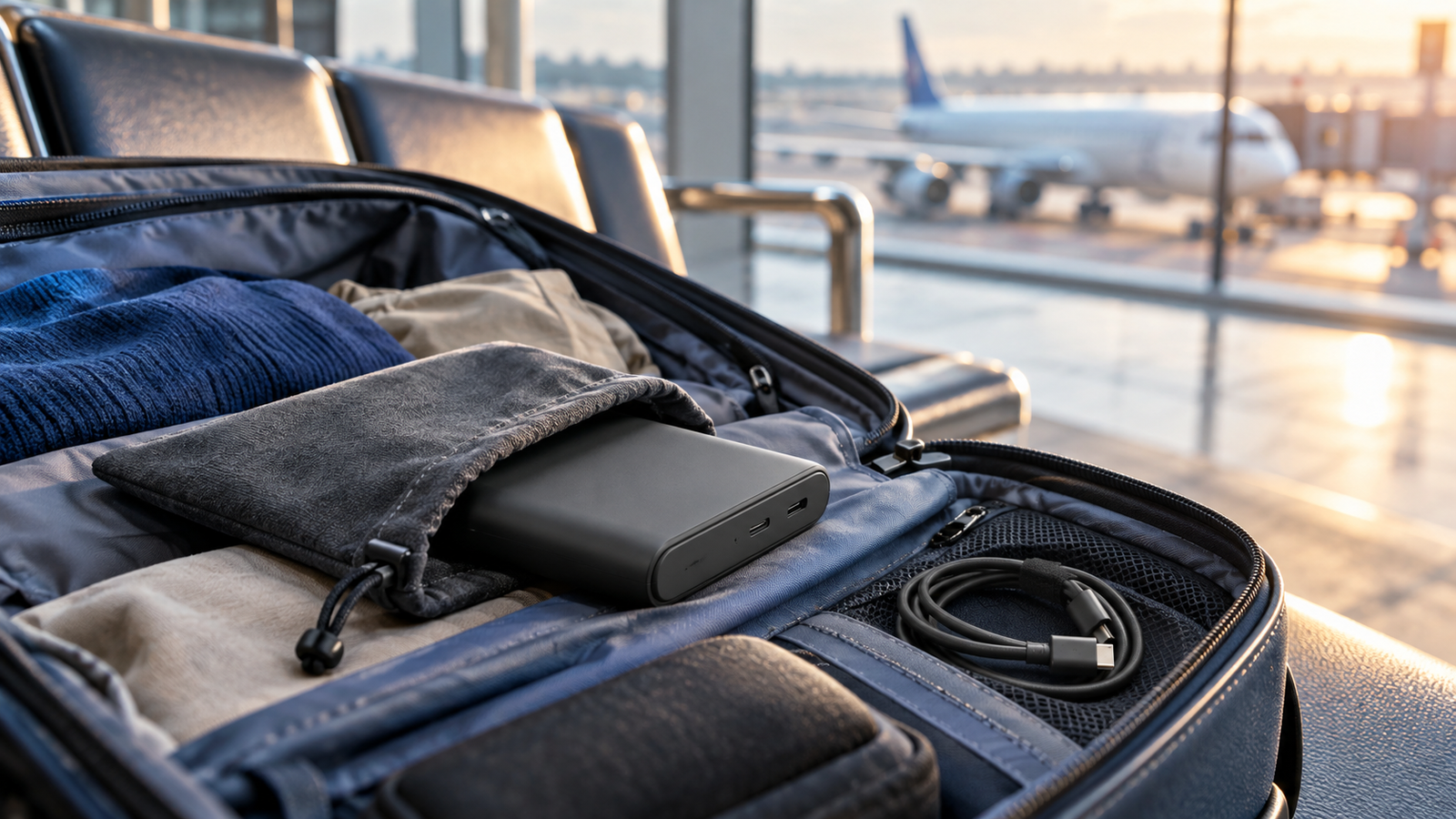
Carry-on versus checked baggage: how to pack safely
Put the power bank in a backpack, personal item, or carry-on suitcase that travels in the cabin. Do not put it in a checked suitcase, even if its Wh rating is very small. If the airline takes your carry-on at the gate or planeside for the hold, remove the bank and keep it with you. FAA guidance explicitly calls out this gate-check situation because a spare lithium battery must remain in the cabin. Tell the crew if you cannot safely remove it yourself.
Prevent a short circuit: keep each bank in a separate protective pouch or its original packaging, make sure exposed contacts cannot touch metal objects, and avoid loose keys or coins beside it. IATA guidance calls for individual protection when not in use. Keep the unit accessible rather than burying it deep inside tightly packed luggage. Avoid crushing, puncturing, or overheating it. Charge it before the travel day if you need energy, but let it cool and follow the operating carrier’s specific guidance; some operators may ask for a lower state of charge.
A swollen, damaged, overheating, or recalled power bank is a safety concern, not a packing puzzle. The FAA says damaged or recalled batteries likely to spark or produce dangerous heat must not be carried unless the hazardous condition is removed or made safe. If one becomes hot, expands, smokes, or burns while traveling, notify airport staff or flight crew promptly. Never hide an incident in a bag.
Can you charge a power bank during the flight?
Do not assume you can. IATA’s 2026 guidance says a passenger power bank must not be recharged while onboard and recommends that it not be used to recharge a portable electronic device during the flight. An airline can set its own stricter rules, including banning power-bank use altogether, choosing a storage location, or limiting charging. Some aircraft have seat power outlets for devices, but the presence of an outlet does not override the rule for recharging the bank. Follow cabin crew instructions and your operating airline’s current policy.
What about a wireless or magnetic power bank?
It is still a power bank for this purpose. Magnetic attachment to a phone does not turn it into a permanently installed phone battery. Keep it in the cabin, check its Wh rating, and prevent unintentional wireless charging while packed. IATA advises separating wireless banks from phones so accidental activation does not start charging inside the bag. If your airline bans use or charging onboard, that applies to wireless as well as wired power banks.
Why international airline rules may differ
There is no single airport counter that applies the exact same power-bank practice worldwide. FAA rules are the U.S. baseline, while IATA’s guidance helps operators interpret international dangerous-goods standards. The 2026 IATA document says no more than two power banks, bans recharging them onboard, and recommends against using them to charge devices. It also acknowledges that implementing the addendum depends on state sovereignty: some jurisdictions adopt changes immediately, some require administrative time, and others require public notice or legal amendment. A carrier may voluntarily adopt stricter conditions earlier.
The same IATA guidance discusses an interim approval provision for 100–160Wh power banks but says that provision will not carry into the 2027 edition; its 2026 table marks power banks in the over-100-to-160Wh range as forbidden. That is precisely why an older generic “two 160Wh banks with approval” statement can mislead international travelers. Before buying a large travel bank, check the policy of every operating airline, including a connecting partner, and get a clear answer about your exact model and Wh. An itinerary sold by one airline may be flown by another.
Read the airline’s dangerous goods or lithium battery page for the latest wording near departure. Search for power bank, not merely “spare battery,” because some policies distinguish them. Check quantity, per-unit Wh, approval route, cabin storage, whether the bank may power a phone in flight, and whether it may be charged from a seat outlet. If a bank is above 100Wh, contact the carrier directly before travel and keep any approval record accessible. The final decision at check-in or boarding remains with the operator and applicable authority.
Examples: 10K, 20K, 27K, and 30K banks
| Marketing size | At 3.7V (example only) | Travel reading |
|---|---|---|
| 10,000mAh | 37Wh | Below 100Wh in this example; cabin only and check quantity/use rules. |
| 20,000mAh | 74Wh | Below 100Wh in this example; a practical reserve for devices. |
| 27,000mAh | 99.9Wh | Near the threshold; actual voltage and printed Wh decide. |
| 30,000mAh | 111Wh | Above 100Wh in this example; some airlines or routes may refuse it even with an FAA approval possibility. |
A model advertised as “airline-friendly” deserves the same checks. Different versions under similar names can have different Wh, labels, and port layouts. The printed 250W or 300W figure on a product refers to output capability, not 250Wh or 300Wh battery energy. A 99.54Wh bank sits below 100Wh but leaves little room for a mistaken assumption if the exact model differs. For the least complicated travel kit, a well-labeled 10K or 20K unit is often sufficient for a phone; a laptop trip may call for more stored energy and suitable USB-C PD output, while still respecting the airline rules.
Anker Prime 27,650mAh Power Bank (250W)
Anker lists this specific A1340 model at 99.54Wh with 27,650mAh capacity and a 250W combined output rating. It illustrates why a prominent wattage is not the flight capacity. The 99.54Wh specification is below the FAA’s 100Wh baseline, but you must still follow the carrier’s quantity and onboard-use policy and verify the exact label on your unit.
A pre-flight power bank checklist
- Read the actual unit. Record the model number and printed Wh. If only mAh and nominal voltage appear, calculate Wh carefully.
- Check every operating airline. Look for a dedicated power-bank policy covering quantity, size, approval, storage and in-flight use—not just a broad TSA page.
- Prefer a clearly labeled sub-100Wh model. It is usually simpler than seeking approval for a larger bank, although airline restrictions still apply.
- Limit the number you take. The 2026 IATA guidance says no more than two power banks; confirm whether your carriers apply that limit.
- Pack in the cabin and protect it. Use a separate pouch; keep contacts safe and the bank accessible. Remove it before a bag is gate-checked.
- Plan for the onboard policy. Do not recharge the bank onboard where prohibited; follow crew directions about using it for devices.
- Inspect its condition. Do not travel with a swollen, damaged, unusually hot or recalled unit. Tell staff if it becomes unsafe.
For a trip with several devices, also make sure the bank’s USB-C output supports your device’s charging mode. Its Wh says how much energy it stores; its per-port W says how quickly it can supply it. Our charger wattage guide helps you match those requirements. If you bring a wall charger as well, our multi-port charger guide explains how to cover a phone and laptop from one outlet after landing.
Frequently asked questions
Can a 20,000mAh power bank go on a plane?
Often yes in carry-on baggage. At a nominal 3.7V it is about 74Wh, below the FAA’s 100Wh baseline. Verify the actual Wh printed on your bank, your operating airline’s quantity rules, and its policy on use during flight. Never put it in checked baggage.
Is a 30,000mAh power bank allowed?
At 3.7V it would be about 111Wh, but the actual label decides. FAA guidance allows the 101–160Wh spare battery range only with airline approval and a two-larger-spare limit. Some airline or international power-bank policies may prohibit this range, so do not bring it without explicit confirmation from each carrier.
Can I put a power bank in a checked suitcase?
No. The FAA and TSA require power banks, treated as spare lithium batteries, to remain in carry-on baggage. Remove them if a cabin bag is checked at the gate.
Can I bring more than two small power banks?
Do not assume so. The FAA’s general U.S. FAQ has no number limit for sub-100Wh personal-use batteries, while IATA’s 2026 power-bank guidance sets a maximum of two and airlines may be stricter. Check your exact route and operating carrier.
Can I charge my phone with a power bank during a flight?
Follow your airline’s current policy and crew instructions. IATA’s 2026 guidance recommends against using a passenger power bank to recharge a portable device onboard and prohibits recharging the bank itself during flight. An airline may forbid use outright.
What if there is no Wh label?
Look for mAh and nominal battery voltage on the unit and calculate Wh = (mAh ÷ 1,000) × V. Carry documentation for the exact model, but acceptance remains the airline’s decision. A bank with a clear printed Wh rating is easier to verify at the airport.
Does the 100W USB-C rating mean it exceeds the 100Wh flight limit?
No. W is output rate; Wh is energy capacity. Check the separate Wh marking. A high-output USB-C bank can be under 100Wh.
The takeaway
Yes, you can commonly bring a power bank on a plane, but put it in cabin baggage, check its real Wh marking, protect it from damage, and follow the operating carrier’s rules. The FAA baseline permits up to 100Wh for personal use, provides an approval path for some 101–160Wh spare batteries, and generally forbids larger units. IATA’s 2026 guidance and airline policies can be stricter, particularly about the number of banks, onboard charging, and power banks over 100Wh. A labeled sub-100Wh model and a quick check of the exact airline policy are the simplest preparations.
Sources and update: FAA Airline Passengers and Batteries; TSA Power Banks; IATA Guidance Document for Operators – Power Banks (2026); Anker A1340 specifications. The mAh-to-Wh table assumes 3.7V solely as an example. Last reviewed September 2026. Verify the airline’s current policy close to departure.



One Comment