Anker Prime 200W vs UGREEN 145W: Which to Buy?
LAPTOP POWER BANK COMPARISON
Anker Prime 200W vs UGREEN 145W
Match single-port power, shared charging and reserve to your everyday setup.
Affiliate disclosure: As an Amazon Associate I earn from qualifying purchases. Walmart links may also earn us a commission at no extra cost to you.
These are retailer search links, not verified matching offers. Confirm the model, version, seller and condition. No live price winner is claimed.
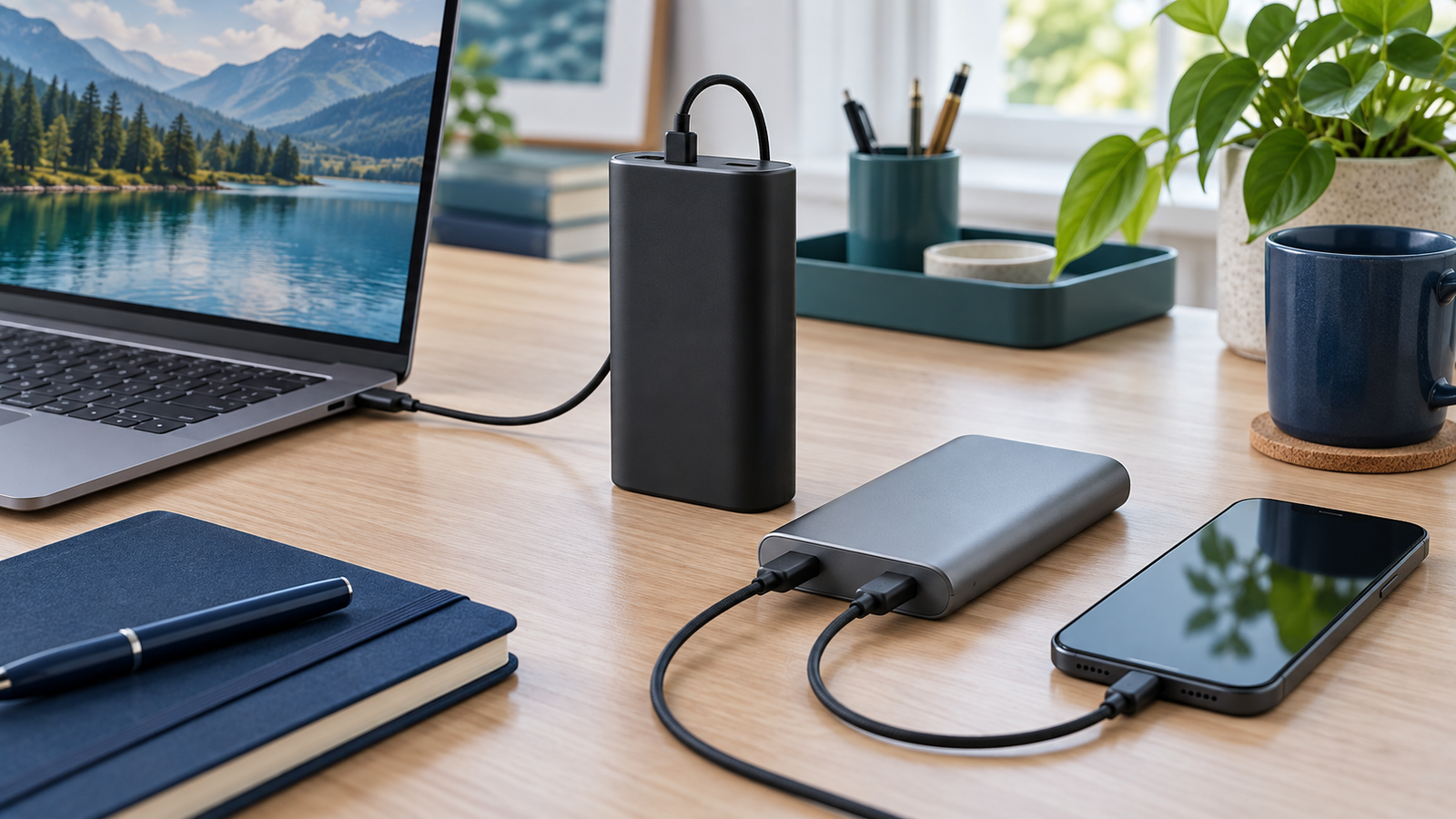
Specification comparison
| Detail | Anker Prime 200W | UGREEN 145W |
|---|---|---|
| Exact model | A1336 / Prime 20K | 90597A / 25K |
| Advertised capacity | 20,000mAh | 25,000mAh |
| Total output ceiling | 200W | 145W |
| USB-C standalone maxima | 100W on either USB-C port | Current US table: C1 140W; C2 65W |
| USB-C recharge ceiling | 100W | 65W |
| Ports | 2 USB-C + 1 USB-A | 2 USB-C + 1 USB-A |
| Output while recharging | Disabled, per Anker | Advertised by UGREEN; verify unit limits |
Specifications checked October 23, 2026 against Anker’s technical introduction and UGREEN’s US product page. Ratings are manufacturer limits, not our measurements. This is a specification-based buying comparison; we have not tested sustained output, usable energy, temperature or recharge time.
Why the bigger wattage number can mislead
Start with the device you need to power, then work outward to the battery. A product name describes a ceiling under specified conditions; it does not tell you what every connected device will receive. Your laptop has its own supported input, and the charging cable and selected port must support the same charging path. Buying the larger total-output number can therefore solve the wrong problem.
Imagine two shoppers with different routines. One charges a single laptop during a commute. The other shares a battery with a colleague during meetings. The first shopper should investigate single-port capability and reserve. The second should investigate the exact simultaneous-port allocation. Neither should make the decision by comparing 200 with 145 alone.
Write down three things before shopping: your laptop model, its accepted charging connection, and the devices you intend to connect at the same time. This turns an abstract specification comparison into a practical shortlist. If neither battery fixes a limitation in the equipment you already own, keeping your current setup may be the better purchase decision.
Version check: the UGREEN listing needs extra attention
The current UGREEN US specification table lists USB-C1 at 140W, while introductory copy on the same page still mentions 100W. Older descriptions and retailer pages may also show different port ratings. This inconsistency matters: a familiar product title is insufficient evidence that the unit in a marketplace listing has the port capabilities you expect.
For this comparison, the table below uses the current US specification table. Before paying, ask the seller for a photograph of the unit label and the matching manual if the listing is unclear. Check the SKU and voltage/current ratings together. Do not assume that one older review, one marketing image or a similar-looking package documents every unit sold under the name.
If you need more than 100W for a particular laptop connection, treat unresolved version information as a reason to choose a clearer listing. The return policy is useful, but it should not replace checking the item before ordering. Save the selected variant and seller details so that the product you receive can be compared with the offer you accepted.
One laptop: choose the connection before the brand
Check the laptop manufacturer’s instructions for the exact model. Identify which USB-C socket accepts charging, whether an adapter is involved, and whether the computer has different limits through different connections. A high-wattage original wall adapter does not by itself establish the charging behavior of every USB-C port on the laptop.
The current UGREEN specification gives it a higher documented single-port ceiling in this comparison. That can matter to a compatible setup above Anker’s individual USB-C limit. It does not establish faster charging for a lower-power computer. If your laptop cannot use the extra headroom, focus on the complete kit, reserve, dimensions and purchase terms.
Also consider what you do while plugged in. A laptop doing demanding work may use much of the incoming energy immediately. A slowly rising battery percentage does not automatically indicate a fault. We have not measured sustained output on either model, so this article cannot promise a particular charging speed, working duration or advantage under heavy workloads.
Two devices: inspect the power-sharing diagram
Anker’s larger combined ceiling makes it worth investigating for shared charging. The important next step is the diagram for the exact ports you will occupy. Individual standalone ratings are not a promise that every socket can supply its maximum together. Adding a third device can change the available allocation again.
Plan around your essential device first. If the laptop must last until an afternoon meeting, a phone top-up should not consume the reserve you need for work. Conversely, a traveler depending on a phone for navigation may reasonably prioritize that phone. A battery can have enough output to connect several devices while still having insufficient energy for all your planned recharges.
Do not promise yourself a specific laptop-plus-phone split without checking the matching manual. This comparison does not independently verify every three-port configuration. If a seller cannot supply the allocation you need, choose a better-documented offer. Our linked individual reviews provide additional buying context, but the manual supplied with the selected unit remains important.
Capacity and runtime are separate questions
UGREEN lists 25,000mAh, compared with Anker’s 20,000mAh. The first printed number is 25% larger, but that arithmetic does not establish 25% more usable laptop runtime. Conversion losses, operating conditions and the connected load matter. We have not performed a matched discharge test and do not publish a measured endurance winner.
Use the watt-hour rating on the actual battery label when comparing energy. Avoid converting advertised milliamp-hours using the laptop’s charging voltage. A storage rating and an output rating describe different parts of the system. The first helps you think about reserve; the second helps you check whether the battery can support the charging connection.
Define the gap you want to cover: a short meeting, a train journey or an afternoon away from outlets. Then consider how much your own laptop normally consumes during that kind of work. This is more useful than expecting a universal number of full charges. A large headline capacity does not guarantee that every laptop will recharge completely.

Recharge input and the charger you already own
Anker’s documented USB-C input ceiling is higher than UGREEN’s in this comparison. That is potentially useful when you have short opportunities to refill the battery. However, the wall charger and cable must also support the required profile. A higher-input battery connected to a modest adapter cannot make the adapter provide power beyond its own supported output.
Someone who refills a battery during a long evening may place little value on extra input headroom. Someone moving between brief charging stops may care much more. Include the cost, bulk and availability of the required wall charger in that decision. A battery can look inexpensive until the missing accessories are added to the checkout total.
We do not estimate full recharge time by dividing rated energy by peak input. That calculation omits charging behavior across the session and does not constitute a test. Allow practical margin before travel, and check whether the wall charger’s output changes when other devices are connected. A shared hotel charging arrangement deserves its own compatibility check.
Pass-through charging changes the desk setup
Anker’s technical introduction states that A1336 disables output while recharging. UGREEN advertises charging devices while the power bank recharges. This documented difference can be more important than total wattage if your plan is to leave a laptop attached while refilling the battery from a wall outlet.
UGREEN’s support for that feature does not prove uninterrupted operation, a particular simultaneous wattage or suitability as an uninterruptible power supply. Check the matching manual and the limits of the exact unit. A feature description is not evidence that the power bank can replace a dock or provide seamless backup during every connection change.
For a desk, consider charging the laptop and battery independently from a suitable multi-port wall charger. That can be easier to plan than routing all power through the battery, provided the wall charger’s sharing arrangement fits both loads. Decide which arrangement you actually need before paying a premium for a portable charging feature.
Cables, portability and the complete kit
Choose a cable explicitly rated for the power profile you intend to use. A cable that charges a phone is not evidence that it supports your laptop’s highest input. Likewise, a high cable wattage cannot raise a laptop or battery beyond its own limits. Check charging capability separately from data transfer and display support.
Measure the compartment where the battery will travel. A flat battery and a taller battery can fit very differently even when their specifications look similar. Include space for the wall adapter and cables. Think about where the battery will sit during use so that a short lead does not pull against a connector or require an awkward position.
Do not assign value to accessories you will not use. An included cable helps only if its capability and length match your routine. A separate charging base may be convenient for one desk and unnecessary for another. Compare the complete setup you need rather than the standalone battery price or the number of items in a bundle.
Amazon vs Walmart: a fair price comparison
The buttons in this article open retailer searches. They are not verified matching offers, and we have not confirmed current Amazon and Walmart checkout prices for both models. There is no declared cheapest retailer here. Search results may include another capacity, a wall charger, a charging base or an older version of a similarly named product.
Compare the exact model, selected variant, seller, condition and included items. Use the same delivery address and include mandatory shipping and applicable tax. Count a coupon only when it applies to your account and selected item. An unavailable reference price should not be treated as a purchasable deal or used to claim a saving.
Read the return terms for the particular offer. A used battery and a new battery are different purchases, and a bundle changes the comparison again. If the seller’s label information conflicts with the description, resolve that before ordering. A small discount is less useful than receiving the correct version with clear support terms.
What to check after delivery
Compare the product label with your saved order details before discarding packaging. Inspect the casing, ports and included cable, and read the supplied instructions. Start with one known-compatible device and the correct port. Then try the actual combination you bought the power bank to support while the return window remains open.
If charging behaves unexpectedly, record the device, cable, port arrangement and approximate battery level. Change one part of the setup at a time so that you can describe the issue clearly to support. A laptop’s workload and battery charge settings can affect what you see, so do not diagnose the battery from one percentage reading alone.
Keep the battery in an open, ventilated location during charging and follow the manufacturer’s operating instructions. Stop using a unit with damaged casing, swelling or other abnormal behavior. This article is a buying comparison rather than a durability or safety certification test, and we do not claim that either product has passed testing by our team.
Related buying guides
For a closer look at each product, read our Anker Prime 200W review and UGREEN 145W review. If a different Anker model is on your shortlist, see Anker 737 vs Prime 200W. For cable shopping, use our charging cable vs data cable guide.
Frequently asked questions
Can Anker Prime 200W send 200W to one laptop?
No. Its individual USB-C output ceiling is 100W. The larger number is the combined output budget.
Is every UGREEN 145W listing the same version?
Do not assume so. Match the label, SKU and manual. The current US page itself includes conflicting single-port descriptions.
Which has more advertised capacity?
UGREEN lists 25,000mAh against Anker’s 20,000mAh. We have not measured a corresponding usable-runtime difference.
Which is cheaper on Amazon or Walmart?
Current matching checkout offers have not been verified. Use the search buttons to compare final cost, exact version and return terms.
Which should I buy for one laptop?
Prioritize the laptop’s accepted input and the exact port rating. Shared output only adds value when your setup can use it.
Our recommendation
Choose Anker when shared charging and its recharge input solve the problem you actually have. Choose UGREEN when reserve or its documented single-port capability is more useful, after resolving the version details. If your laptop needs neither model’s extra capability, buy around complete-kit cost and convenience. Check the exact available offers before deciding.
About the author
Daniel Carter — Charging Technology Researcher. This guide uses manufacturer documentation and practical buying analysis. Recommendations are editorial judgments. No hands-on test results or verified retailer savings are claimed. Updated October 23, 2026.