

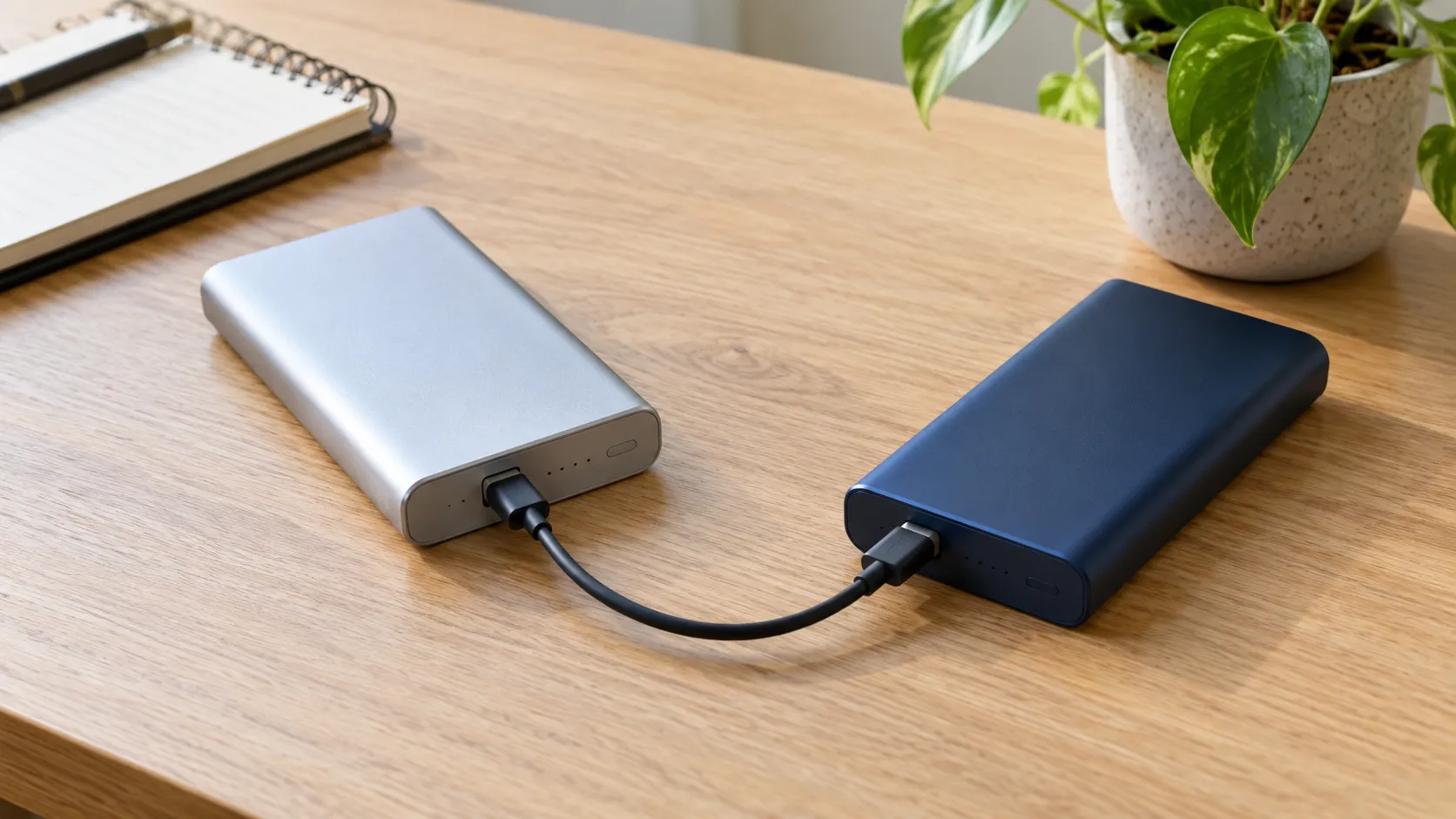
10,000mAh vs 20,000mAh Power Bank: Which Should You Buy?
CAPACITY COMPARISON • EVERYDAY CARRY & TRAVEL
Quick answer: Choose a 10,000mAh power bank for a lighter daily backup when you can recharge regularly. Choose 20,000mAh when you need more reserve for long days, shared charging, or time away from outlets. Neither capacity guarantees fast charging or laptop compatibility: check USB-C output, input, and supported charging protocols separately.
As an Amazon Associate I earn from qualifying purchases. We may also earn a commission through other affiliate links, at no extra cost to you. Store buttons open search results; match the exact model and seller before buying.
A 10,000mAh vs 20,000mAh power bank decision starts with your routine, not the largest number on the package. A battery you comfortably carry can be more useful than a larger one left at home. Extra reserve matters when a day stretches into an evening, a second person needs power, or the next working outlet is uncertain.
This guide compares capacity classes rather than declaring a single tested winner. It uses manufacturer documentation for specific label examples and clearly marked calculations for energy estimates. It does not claim hands-on runtime, current retailer prices, or a guaranteed number of phone charges.
Start here for one phone, ordinary commutes, and frequent access to a wall charger.
Start here for longer outings, several devices, and fewer opportunities to recharge.
10,000mAh vs 20,000mAh: quick comparison
| What matters | 10,000mAh class | 20,000mAh class |
|---|---|---|
| Stored energy | Smaller reserve; check the Wh label | Roughly twice the energy at the same reference voltage |
| Daily carry | Usually easier to fit into a small bag | Usually better suited to a backpack or travel pouch |
| Charging speed | Depends on output and device support | Depends on output and device support |
| Recharging the bank | Less energy to replace | More energy to replace; input wattage becomes especially important |
| Two-device use | Possible on suitable models, with less reserve | More reserve, but check shared-port limits |
| Laptop use | Check voltage profiles, wattage, and energy | Capacity alone still does not establish compatibility |
| Best starting point | Phone backup between reliable outlets | Long outings or several charging needs |
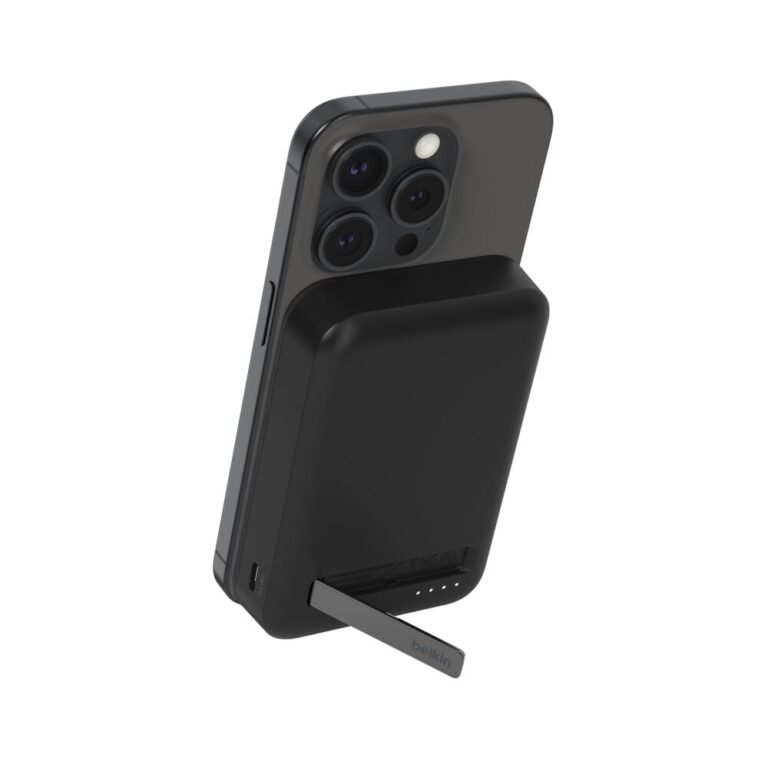
These are buying tendencies, not specifications for every product. A slim premium 20,000mAh model may be easier to pack than an unusually bulky 10,000mAh model with a stand, magnetic pad, or heavy casing. Compare dimensions and weight for the exact products on your shortlist.
When 10,000mAh makes more sense
You mainly need a phone top-up
Think about what happens on an ordinary day. If your phone leaves home charged and needs an afternoon boost before you reach an outlet, the smaller class is a sensible place to begin. You are buying a practical buffer rather than replacing access to mains power for several days.
Carry comfort deserves as much attention as capacity. Put the proposed dimensions beside the pocket or pouch you actually use. A built-in cable might remove one loose accessory, while an awkward connector position can make charging in your bag inconvenient. Check whether your phone case leaves enough room for the plug.
You can recharge every evening
A predictable evening outlet reduces the value of unused reserve. The useful question is how much energy you need between recharging opportunities. Buying double the nominal capacity may provide little daily benefit if the smaller bank consistently covers that gap and you reliably refill it.
That does not make the smallest product automatically the cheapest long-term choice. Consider seller reliability, warranty handling, replacement cable cost, and whether the bank supports your phone’s charging standard. A low price loses its appeal when the accessory cannot deliver the charging behavior you expected.
You want a simple backup kit
For a one-phone setup, begin with a bank, one suitable cable, and a compatible wall charger already in your home. Avoid paying for numerous ports you will rarely use. If your routine includes earbuds or a watch, look for documented support for low-current accessories instead of assuming every bank stays active at small loads.
Filter for 10,000mAh, USB-C input and output, a published weight, and the protocol your phone uses. Check the manual for the exact model number. Prefer an appropriate charging setup over an unexplained “fast” label.
When 20,000mAh is worth the extra space
Your day has several charging demands
A navigation-heavy day, an evening event, and a second device create a different requirement from a short commute. The larger class gives you more energy to allocate. It can be easier to share one larger bank than to keep checking whether a smaller reserve will cover the next device.
Write down the devices before counting ports. A phone plus earbuds is different from two phones plus a tablet. Decide which devices must charge together and which can wait. This tells you whether to prioritize reserve energy, simultaneous output, or a lightweight design.
You cannot rely on frequent outlets
Extra capacity is useful when you may miss a planned charging stop. Examples include long work shifts, outdoor days, and journeys with uncertain outlet access. Build a margin around your actual needs instead of choosing a bank that only works if every recharge opportunity happens exactly as planned.
Remember the preparation burden. A larger bank is useful only when it starts with enough charge. Make checking its level part of packing, and confirm your available adapter can refill it within the time you have. A high output rating on the front does not tell you how quickly the bank itself recharges.
You carry a tablet or compatible laptop
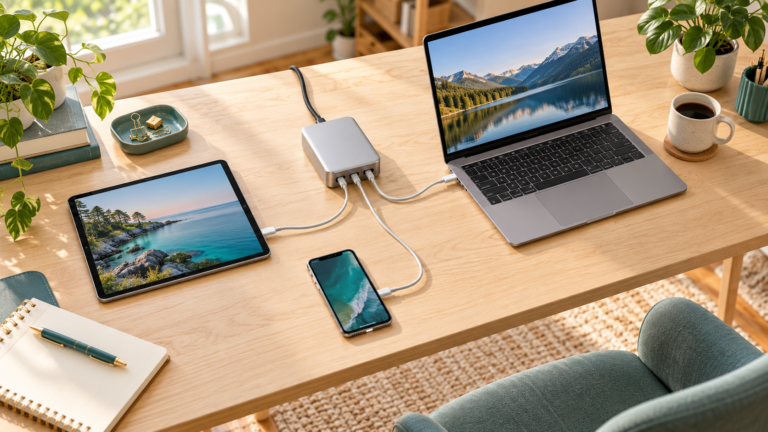
More stored energy creates a larger budget, but you still need suitable electrical output. Before buying for a laptop, look up the computer’s supported USB-C charging requirements and the power bank’s individual port specifications. Compare those directly. Do not infer compatibility from the presence of a USB-C socket.
For detailed laptop selection, see how many watts a laptop power bank needs and whether a 20,000mAh power bank can charge a laptop. Those checks should come before adding an expensive laptop-focused model to your cart.
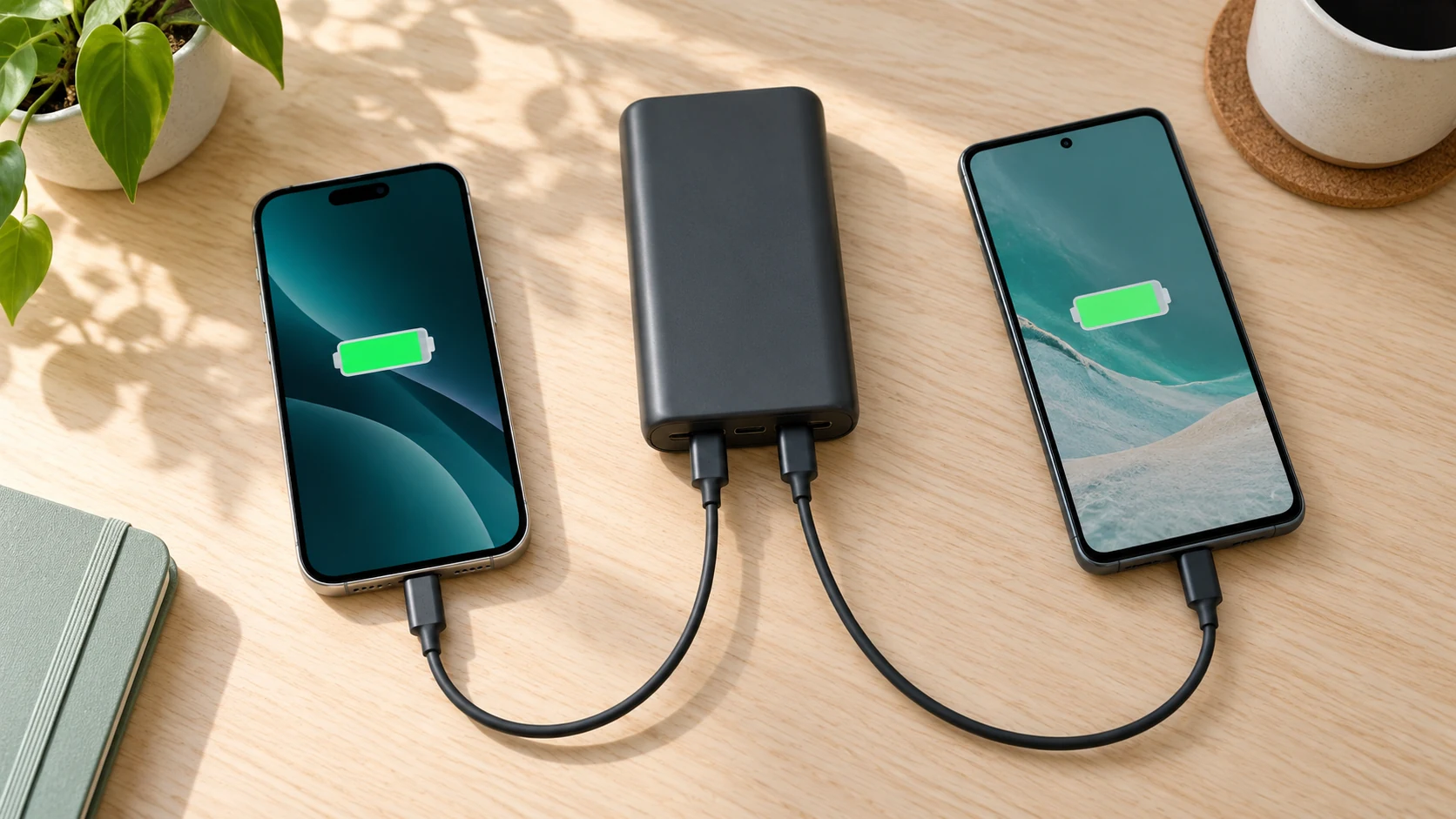
Compare watt-hours before estimating phone charges
Milliamp-hours describe electrical charge. Watt-hours describe energy and incorporate voltage. When two capacity labels use different reference voltages, comparing mAh alone can hide a meaningful difference. Read the printed Wh value where available, especially when moving between phone batteries, power banks, and laptop batteries.
Calculation: Wh = (mAh ÷ 1,000) × nominal voltage. At an assumed 3.7V reference, 10,000mAh corresponds to 37Wh and 20,000mAh corresponds to 74Wh. These are illustrative calculations; use the actual voltage or Wh printed on your product.
Real labels show why the voltage matters. NITECORE’s NB10000 manual lists 10,000mAh at 3.85V, or 38.5Wh. Its NB20000 Gen3 page lists 20,000mAh at 3.6V, or 72Wh. These specific examples should not be treated as universal energy values for their capacity classes. See the NB10000 manual and NB20000 Gen3 specifications.
A transparent planning example
Suppose a hypothetical phone battery stores 18Wh. Suppose, purely for planning, 80% of a power bank’s labeled energy ultimately becomes energy stored in that phone battery. Under those assumptions, a 37Wh bank would provide 37 × 0.8 ÷ 18 = about 1.6 equivalent full charges. A 74Wh bank would provide about 3.3.
This is arithmetic, not a product test or a promised efficiency rate. Different devices, temperatures, charging methods, battery condition, and usage can change the outcome. “Equivalent full charges” also means accumulated energy: several partial top-ups can add up to the same amount without the phone ever starting at zero.
If the phone is playing video or running navigation while connected, some supplied energy runs the phone rather than filling its battery. That makes the battery percentage a poor standalone measurement of power bank performance. For more detail, read why usable power bank capacity differs from the advertised number.
Capacity does not determine charging speed
Separate the size of the energy reserve from the rate at which it can be delivered. A larger tank does not establish a higher output rating. Read the individual USB-C port’s voltage and current profiles, the supported protocol, and the limits when another port is in use.
The USB-IF description of USB Power Delivery explains flexible power delivery and devices taking the power they require. That does not mean every USB-C bank implements every PD capability. The bank, device, and cable must support the charging mode you want to use.
For example, the NB20000 Gen3 page lists up to 22.5W from an individual USB-C output and a separate 15W total-output specification. It also lists up to 18W input. This illustrates why input, single-port output, and shared output belong on separate lines in your comparison; it is not a recommendation for a high-power laptop.
If your Samsung phone needs a particular PPS profile for the desired mode, check that profile explicitly. If your cable has a lower supported current or power limit than your intended setup, replace the cable with a suitable one. Our USB PD vs PPS guide explains the distinction before you buy.
How long will each bank take to recharge?
Use input specifications rather than output marketing. A bank advertised for strong phone output may accept a more modest input. Your wall adapter must offer an input profile the bank accepts, and the cable must support that connection. A higher-rated adapter cannot make the bank exceed its own supported input.
As a mathematical lower-bound example, replacing 37Wh at a constant 20W would take 1.85 hours. Replacing 74Wh at the same constant power would take 3.7 hours. Actual charging takes longer because input power is not constant throughout the session and losses must be supplied too. These numbers are not recharge-time claims for retail products.
Ask whether you normally have an entire evening or only a brief stop to recharge. A larger bank with an appropriate input can suit a short-stop routine better than a smaller bank with slow input. Compare documented manufacturer recharge conditions where available, including the adapter required to achieve them.
One 20,000mAh bank or two 10,000mAh banks?
One larger bank simplifies packing and gives you a single battery level to track. Two smaller banks let two people carry independent backups and can spread equipment between bags. Neither arrangement is automatically lighter, cheaper, or faster; compare the combined weight and all the cables you would carry.
Two banks also mean two items to recharge and maintain. If your charger has limited outputs, refilling both may require taking turns. On the other hand, independent banks can be convenient when two people split up. Choose around who carries the equipment and how reliably it gets recharged.
Compare Amazon and Walmart without mismatching products
Start with the manufacturer’s exact model number. Retail titles can mix capacity, generation, cable type, and marketing names. A lower price for a different version does not establish a better deal on the product you intended to buy. Check whether the selected color or bundle changes the model or included accessories.
Next compare checkout cost, seller identity, delivery date, returns, and warranty eligibility. A coupon may have account requirements, while a bundle may include a cable you already own. Calculate the total you would actually pay rather than comparing an advertised discount percentage.
Filter for 20,000mAh, then choose the output class your devices require. Phone-focused and laptop-focused models serve different needs. Store search results are a starting point; verify the exact listing before checkout.
No live price winner is claimed here. Prices, stock, and sellers can change. For seasonal shopping, use our Black Friday power bank buying checklist to judge the product first and the promotion second.
Your final pre-purchase checklist
- List the devices and how often you can reach an outlet.
- Check nominal Wh, actual weight, and dimensions.
- Confirm USB-C input and output rather than assuming both.
- Match the required charging protocol and per-port power.
- Read the shared-output table if using several ports.
- Include a suitable cable and wall adapter in the total cost.
- Compare exact model numbers, sellers, returns, and checkout totals.
If the smaller class covers your normal gap between outlets, prioritize a bank you will carry consistently. If you regularly share power or need a larger reserve, start with the 20,000mAh class and check its size and refill requirements. For a broader accessory decision, see wall charger vs power bank.
Frequently asked questions
Is a 20,000mAh power bank twice as good as 10,000mAh?
It offers roughly double the stored energy only when compared at the same reference voltage. Value also depends on weight, output, input, compatibility, and whether you need the extra reserve.
Will 20,000mAh charge my phone faster?
Not simply because of the capacity. Charging speed depends on the bank’s output, the phone’s supported charging mode, the cable, and current charging conditions.
Is 10,000mAh enough for daily use?
It can be a sensible daily backup for one phone when you recharge regularly. Estimate your needs using battery energy and your actual routine rather than assuming a fixed number of full charges.
Does 20,000mAh guarantee laptop charging?
No. Check the laptop’s USB-C charging support, required voltage and wattage, the bank’s individual port output, and the cable rating.
Which capacity is better for travel?
Choose around outlet access, device needs, and carry comfort. For flying, separately check the printed Wh rating and the current rules of your airline; capacity alone is not a travel approval.
Should I buy the cheapest listing?
Compare the exact model, seller, return policy, warranty eligibility, and final checkout total first. An unfamiliar listing with unclear specifications is not a like-for-like saving.

One Comment